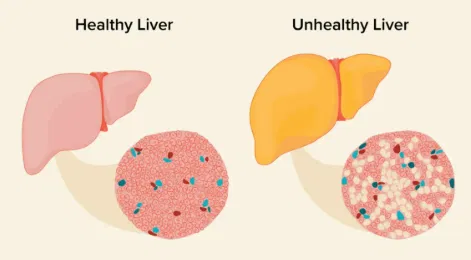
When we talk about liver health, most people think liver problems are obvious, painful, or easy to detect. But the reality is quite different: fatty liver is silent, develops slowly, and can progress for years without causing any noticeable symptoms. However, there is a very common habit that almost everyone with fatty liver shares, even without knowing it: living with a metabolic imbalance that begins long before the liver “screams.”
Even if you don’t notice it, your body is sending signals. If you feel heavy after eating, have trouble losing belly fat, have high triglycerides, or are told that “everything is normal,” but you don’t feel well… you could be facing a liver problem that went undetected.
The core of the problem: an overloaded metabolism
Most people who develop fatty liver share the same silent triad:
1. Insulin resistance
The body produces too much insulin to handle the excess sugar and energy. This causes the liver to work overtime, store more fat, and become overloaded.
2. Visceral Fat
It doesn’t matter if a person is thin or robust: the fat surrounding the organs is the most dangerous. There’s even a term, “metabolically obese thin”: little fat on the outside, a lot of fat on the inside.
3. Chronic Low-Grade Inflammation
It doesn’t hurt, you can’t feel it, but it’s there. And it sustains the entire metabolic cycle that slowly damages the liver.
When this combination occurs, the liver begins to store excess energy. First, it stores glucose, then fat. When it can’t store any more, it sends it to other parts of the body. Over time, it all becomes a vicious cycle: more insulin → more fat → more inflammation → more liver damage.
Signs That Could Be Warning You Without You Noticing
These signs don’t always seem important… until you connect the dots:
Fatigue after eating.
Brain fog.
Waist circumference greater than 90 cm (in men it can be higher).
Triglycerides above 100 mg/dL.
Low HDL cholesterol.
Spots on the neck or skin folds.
Frequent snoring.
Elevated uric acid.
Constant hunger or sweet cravings.
Increased abdominal fat even though all tests come back normal.
If you have three or more of these signs, it’s very likely that insulin resistance is the underlying issue… and your liver is showing it.
Essential Tests You Can Request from Your Doctor
To understand what’s really going on, it’s not enough to just measure glucose. Here’s what’s important:
Fasting and postprandial glucose levels.
Fasting and postprandial insulin levels.
HOMA-IR Index.
Complete lipid profile.
Glycated hemoglobin.
Uric acid.
Vitamin D.
Liver ultrasound.
GGT, transaminases, and alkaline phosphatase.
Ferritin and CRP (inflammatory markers).
With this comprehensive analysis, you can see the whole picture, not just an isolated scene.
The habits that most damage your liver without you even noticing: There are factors that are almost always present in those who develop fatty liver disease:
– Excessive sugar and refined flour.
– Beverages with fructose (juices, sweetened yogurts, sodas).
– Ultra-processed foods and snacks.
– Frequent alcohol consumption.
– Poor sleep.
– Sustained stress.
– Lack of muscle mass.
– Sedentary lifestyle.
The liver doesn’t have enough resources to handle such a heavy daily workload.
What you can start doing today
Fatty liver isn’t a death sentence, and in the vast majority of cases, it can be reversed at home with simple and consistent habits.
1. Completely eliminate sugars and juices
No natural juices, honey, unrefined cane sugar, syrups, or sugary drinks.
2. Increase your intake of green and cruciferous vegetables
Broccoli, cauliflower, cabbage, spinach… all of these help with liver detoxification.
3. Prioritize protein and healthy fats
Eggs, chicken, fish, legumes, olive oil, avocado, nuts.
4. Build muscle
Walk after every meal and add strength training.
5. Sleep like medicine
The liver works best between 1 and 3 a.m. Sleep is key for regulating insulin.
6. Manage stress
Practice breathing exercises, take active breaks, and limit screen time at night.

Related Posts

The Deadly Ingredient Hiding in Your Kitchen: Why That Bitter Taste Could Be a Fatal Warning
You may think you’re serving a healthy, home-cooked meal, but an unusually bitter taste could signal something more serious than bad seasoning. Food safety experts warn that…
Viewers Spot a Subtle Detail in Coca-Cola’s Iconic Logo
Some people have noticed that the second “C” in the Coca-Cola logo looks like a smile—and once you see it, it’s hard to ignore. The familiar red-and-white…

A Viral ICU Rescue Clip Wasn’t What It Seemed
A tense hospital video recently spread across social media, showing what appeared to be a nurse rushing to save an unconscious patient in an intensive care setting….

‘Most beautiful girl in the world’ Thylane Blondeau marries French DJ in fairytale Paris wedding
Thylane Blondeau was six when the world decided how she should look. Now 25, she has stepped into a new chapter—one defined on her own terms. Once…
I found this tiny white stick in my son’s room and was too embarrassed to ask him does anyone know what it is?
What I thought was a mysterious gadget turned out to be something surprisingly ordinary. After searching online and comparing photos, I discovered it wasn’t a vape, hidden…

Charlotte Airport Faces Flight Delays Followin
Operations at Charlotte Douglas International Airport experienced temporary delays after a Frontier Airlines aircraft was involved in an unusual ground servicing incident before departure. Although the event…