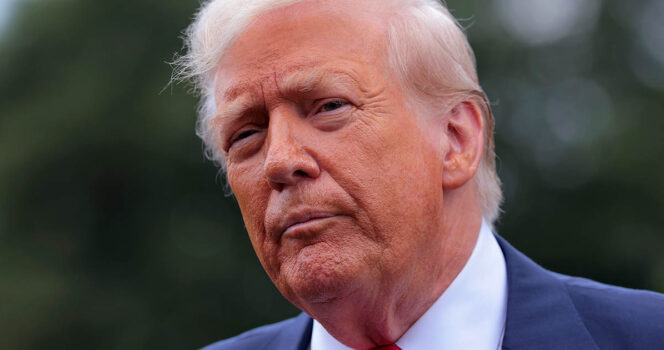
On Thursday, Donald Trump underwent an examination for swelling in his leg. Later, it was announced that the president had been diagnosed with chronic venous insufficiency. Now, an expert has provided more details about what the condition actually entails. Although it’s not life-threatening, it could seriously affect his everyday life.
Donald Trump’s noticeably swollen ankles have been a subject of public discussion, especially after recent public appearances and photographs fueled further health speculation
On Thursday, Donald Trump underwent a “comprehensive examination, including diagnostic vascular studies,” with the White House Medical Unit. White House Press Secretary Karoline Leavitt read a note from the president’s physician, Sean Barbabella.
“I know that many in the media have been speculating about bruising on the president’s hand and also swelling in the president’s legs,” she said Thursday. “So, in the effort of transparency, the president wanted me to share a note from his physician with all of you today.
In the memorandum, Barbabella stated that Donald Trump had “noted mild swelling in his lower legs.”
“The president underwent a comprehensive examination, including diagnostic vascular studies. Bilateral lower extremity venous Doppler ultrasounds were performed and revealed chronic venous insufficiency, a benign and common condition, particularly in individuals over the age of 70,” the statement read.
Donald Trump diagnosed with chronic venous insufficiency
Dr. Sean Barbabella further noted there was no evidence of deep vein thrombosis or arterial disease, which would be more serious conditions. The president’s lab testing was all “within normal limits.”
He also underwent an echocardiogram and there were “no signs of heart failure, renal impairment, or systemic illness were identified,” Barbabella wrote.

Related Posts
The Deadly Ingredient Hiding in Your Kitchen: Why That Bitter Taste Could Be a Fatal Warning
You may think you’re serving a healthy, home-cooked meal, but an unusually bitter taste could signal something more serious than bad seasoning. Food safety experts warn that…

Viewers Spot a Subtle Detail in Coca-Cola’s Iconic Logo
Some people have noticed that the second “C” in the Coca-Cola logo looks like a smile—and once you see it, it’s hard to ignore. The familiar red-and-white…

A Viral ICU Rescue Clip Wasn’t What It Seemed
A tense hospital video recently spread across social media, showing what appeared to be a nurse rushing to save an unconscious patient in an intensive care setting….

‘Most beautiful girl in the world’ Thylane Blondeau marries French DJ in fairytale Paris wedding
Thylane Blondeau was six when the world decided how she should look. Now 25, she has stepped into a new chapter—one defined on her own terms. Once…

I found this tiny white stick in my son’s room and was too embarrassed to ask him does anyone know what it is?
What I thought was a mysterious gadget turned out to be something surprisingly ordinary. After searching online and comparing photos, I discovered it wasn’t a vape, hidden…
Charlotte Airport Faces Flight Delays Followin
Operations at Charlotte Douglas International Airport experienced temporary delays after a Frontier Airlines aircraft was involved in an unusual ground servicing incident before departure. Although the event…