A television presenter adorned with a traditional Māori face tattoo has gracefully responded to troll comments from a viewer, reaffirming pride in her cultural heritage and identity.
Facial tattoos often ignite debates online, with some individuals asserting that tattoos should be confined to the body, while others embrace the cultural significance behind them.
Oriini Kaipara, 41, a trailblazing TV presenter, made history when she joined New Zealand’s Newshub as a newsreader, becoming the first primetime TV news bulletin presenter with a moko kauae, a revered cultural marking worn by Māori women.

Māori, the indigenous Polynesian people of mainland New Zealand, regard moko kauae as profound symbols of heritage and identity. These facial tattoos, traditionally received on the lips and chins, symbolize a woman’s familial connections, leadership within her community, and honor her lineage, status, and capabilities.
However, amidst the accolades, one viewer, known as David, voiced his discontent with Kaipara’s moko kauae in an email to Newshub.
“We continue to object strongly to you using a Māori newsreader with a moku [moko] which is offensive and aggressive looking,” he wrote, per the Daily Mail. “A bad look. She also bursts into the Māori language which we do not understand. Stop it now.”
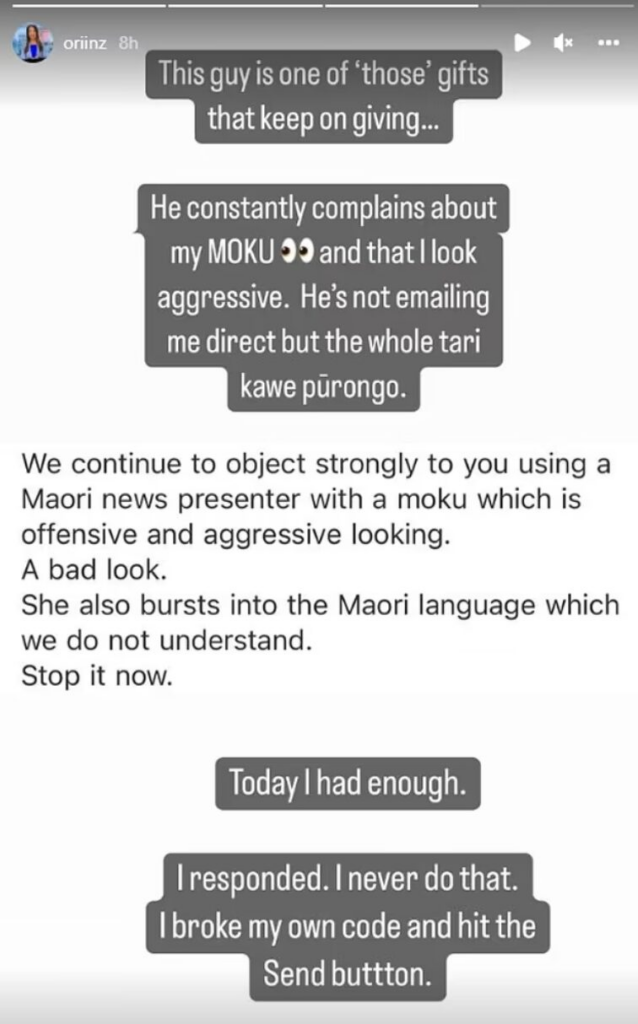
Undeterred by David’s disparaging remarks, Kaipara bravely addressed the issue head-on, sharing screenshots of the messages on her Instagram story and responding with grace and dignity.
“Today I had enough. I responded. I never do that. I broke my own code and hit the send button,” she wrote on an Instagram story accompanied by a screenshot of David’s message.
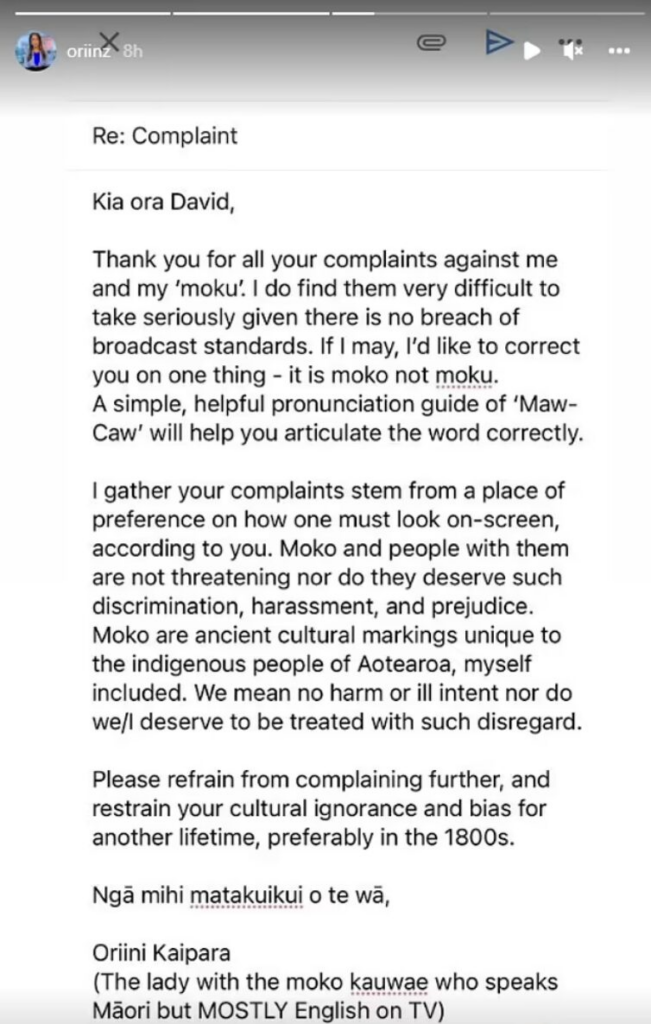
Kaipara also shared her email response to David, where she wrote that she was unable to take his complaint seriously “given there is no breach of broadcast standards.”
She also made a point of correcting his spelling of moko, as David had referred to hers as “moku”.
In her email, Kaipara continued: “I gather your complaints stem from a place of preference on how one must look on-screen according to you. Moko and people with them are not threatening nor do they deserve such discrimination, harassment and prejudice.
“We mean no harm or ill intent nor do we/I deserve to be treated with such disregard,” she continued. “Please refrain from complaining further, and restrain your cultural ignorance and bias for another lifetime, preferably in the 1800s.”
Despite David’s harsh criticism, Kaipara was quick to state that she mostly receives comments of praise, and that cruel trolls are few and far between.
In an interview with the New Zealand Herald shortly after she responded to David’s complaint, Kaipara spoke about how important it is to have more Māori advocates: “The fact that my existence triggers some people is testament to why we need more Māori advocates in key roles across every sector.”
All in all, Kaipara’s dignified response serves as a powerful reminder of the importance of cultural pride and resilience in the face of adversity – and she’s inspiring others to embrace their identities unapologetically and challenge discriminatory attitudes.
What do you think of this story? Let us know in the comments!
